

AI, Non-Coders, and the Speed of What’s Now Possible
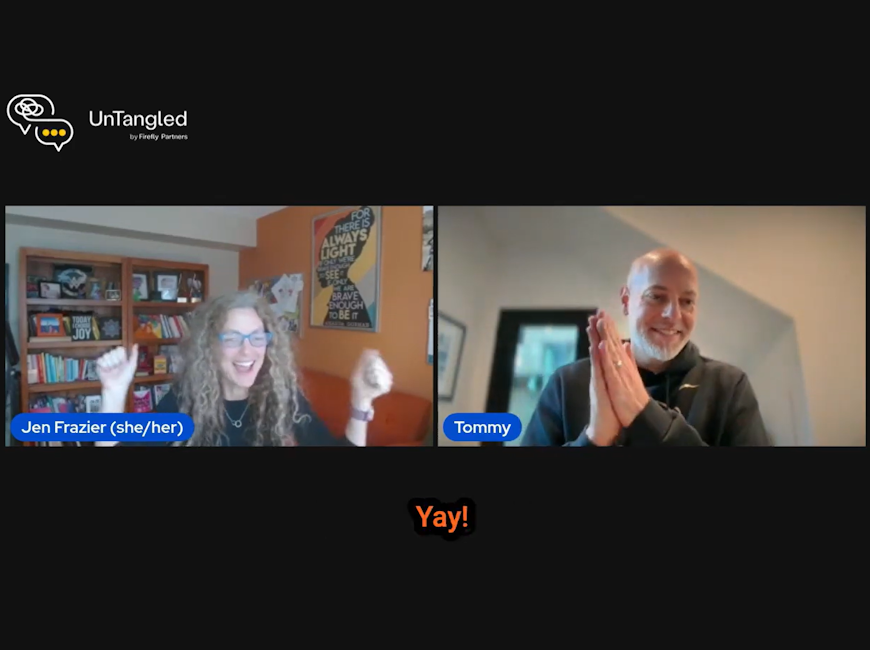
UnTangled is back. And so is that slightly surreal feeling that the future showed up early.
When Tommy and I kicked off this season, we were talking about digital and AI in the social good sector. But the conversation quickly zeroed in on something bigger: What happens when you do not need to be a coder to build real software?
Not a side project. Not a hobby tool. Production-ready applications.
Tommy showed it live. He typed a plain English prompt asking for an analytics dashboard with charts, status breakdowns, and agreement types. The system wrote the code, generated the tests, integrated it into his existing stack, and deployed it to the cloud.
He did not write a single line of code. He evaluated the output. And that distinction matters.
AI Did Not Just Improve. It Jumped.
We have been talking about generative AI for a few years now. Writing help. Brainstorming. Image generation. This is different.
Tommy described working with AI as being “exactly like talking to an engineering human.” You explain what you want. It builds. You review what shows up. It adjusts. Sometimes it gets it wrong. You correct it. It keeps going.
That back and forth is happening in English.
Two years ago, the idea that a non-coder could build a production-level application stack in months would have sounded absurd. He shared that he started the journey in September and then, heading into December, decided to “completely refactor, rebuild this entire thing on Google Cloud using this approach.”
That timeline alone should get our attention.
Let’s Be Clear. This Is Not Magic.
There is a lot of marketing that says, “If you can dream it, you can build it.”
Tommy was refreshingly direct: “The marketing is marketing… This is gonna take a lot of time.”
AI is not replacing thinking. It is amplifying it.
You still need product judgment. You still need systems thinking. You still need clarity about what you want and the discipline to iterate when the first version is not quite right.
He is not coding. But he is architecting.
That is the shift.
When Non-Coders Can Build
So what actually changes?
First, speed. The time between idea and functional prototype collapses. That changes who gets to experiment. For nonprofits and social impact organizations that rarely have extra budget for custom builds, that is significant.
Second, power. For a long time, building digital tools required access to specialized talent and funding. Now, the barrier is lower. Not gone. Lower. People who deeply understand mission, programs, and community impact are closer to the build layer than ever before.
That is exciting. It is also destabilizing.
Is It Excitement or Fear?
Honestly? Both.
There is something electric about watching someone describe what they want in plain English and see it turn into working software. It feels a little like living inside a science fiction movie we used to joke about.
There is also a quiet anxiety underneath it. If non-coders can build, what does that mean for coders? If AI can write code, what changes about technical roles?
Tommy made another point I appreciated. He has worked with engineers for decades and said coding is “one of the most underappreciated skills of creativity.”
With these AI tools, that type of creativity does not disappear.
The dividing line is shifting, however. And we need to pay attention to that shift. It is no longer only about whether you can write syntax. It is about whether you can think clearly about systems, structural problems, and guide a build process.
That is a very different skill set.
What This Means for Social Good
Our sector has big ambitions and limited resources. We often make do with tools that were never designed specifically for our work.
If AI lowers the cost of building custom solutions, even incrementally, that creates leverage. Real leverage.
But speed without strategy creates messes quickly.
We do not need everyone to become a vibe coder. We do need leaders to understand what is now possible so we can make intentional decisions about what to build, what to automate, and what still requires human care.
The technology is accelerating. That much is obvious. The more important question is what we choose to build with it and who actually does the building.
And that is a conversation worth having.
Watch the full episode here:
And if you are ready to talk about how to get your organization started on your AI journey, let’s talk!
Thanks! You’ll hear back within 48 business hours
In the meantime, why not check out our latest case study?

Whether you need help with a project, want to learn more about us, or just want to say hi, you’ve come to the right place.