

UnTangled with Peter Genuardi: Using AI to Strengthen the Social Safety Net
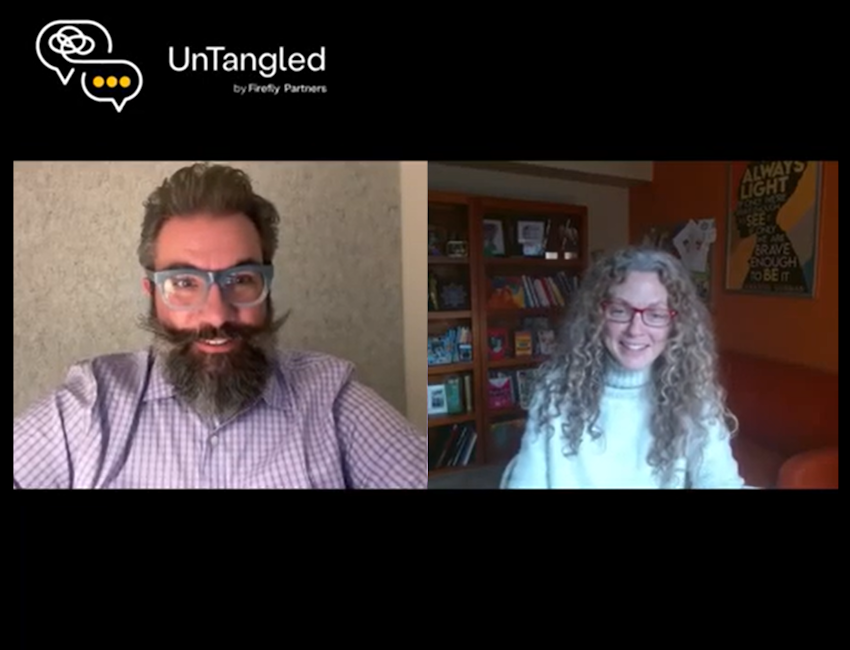
There is a quote Peter Genuardi dropped in our UnTangled conversation last week that keeps echoing in my head: “I’ve seen the best minds of my generation focused on getting people to click on things.”
He was not being facetious. He was being honest. Decades of extraordinary human talent and obscene amounts of money have been poured into figuring out how to manipulate your behavior online. And it worked. Beautifully, terrifyingly well. And now that same brain trust, those same dollars, those same power structures have built the generative AI tools that are quickly reshaping everything about how we live and work.
So here is the tension I cannot shake, and that I think a lot of us in the social good sector are quietly wrestling with. Audre Lorde told us, “the master’s tools will never dismantle the master’s house.” And yet here we are, using tools built by the very people and systems many of us spend our working lives pushing back against, to try to do genuine good in the world.
Can you build something truly liberatory on a foundation poured by people whose worldview you fundamentally oppose? I do not have a clean answer. But I think that question is worth asking out loud. And Peter’s work is one of the most interesting stress tests of it that I have come across.
Because what his team at See the Stars has done is take those finely tuned tools of behavioral manipulation and point them directly at keeping people from losing their Medicaid.
What Peter Actually Built
Peter is the founder and principal of See the Stars, and what his team has built is called Beacon. The short version is this: a platform that uses the same targeting and behavioral tools that power digital fundraising and e-commerce to connect people in need with the public benefits programs that actually exist for them.
We are talking about SNAP. Medicaid. Property tax rebates. Job training. Nutritional assistance. Programs that exist and are funded and that millions of people are either not enrolled in or at serious risk of losing because the systems designed to keep them connected are, to put it charitably, a disaster.
Peter told me they helped just over a million people in 2025 alone navigate from confusion into real programs that could change their circumstances. That is a significant, impressive number representing a substantial impact on a lot of lives. A LOT of lives.
The Problem They Are Solving Is Getting Worse on Purpose
HR1, the federal legislation currently working its way through Congress, is designed in significant part to require people to re-enroll in Medicaid and SNAP far more often than before. On its face, that sounds like accountability. In practice, it is a mechanism for stripping people of programs they rely on by burying them in administrative friction they cannot navigate. People miss paperwork. They miss deadlines. They do not know the rules changed. And then they lose healthcare. It is cruel, and it is the reality Peter and his team are building directly against.
Peter’s framing: rural hospitals are funded in large part by patients who carry Medicaid. When those patients lose coverage and stop coming through the door, hospitals close. Not just for Medicaid patients. For everyone in those communities.
So yes. This is urgent. And yes, the speed at which Beacon is being built matters.
The Speed Part Is Actually Kind of Unhinged
One of the things that keeps coming up in UnTangled conversations is just how fast the development timeline has compressed. Peter described using Claude to generate functional specifications and engineerable user stories for new features, something that used to require weeks of back and forth between strategists and developers. He is feeding those specs into Claude Code to build on a Node and React stack, integrating with their data warehouse, and iterating at a pace that was not possible even two years ago.
For the property tax rebate tool alone, his team used AI to collapse 650 eligibility questions across 155 potential state programs down into 30 normalized questions. A user might only have to answer five of them to find out they qualify for a thousand-dollar rebate they had no idea existed.
That is not magic. That is what it looks like when you apply real systems thinking and the right tools to a problem that has historically been too complex to solve at scale.
The Human in the Loop Is Non-Negotiable
Peter was clear that his team is not just letting the machines run. There is a senior engineer and architect reviewing AI-generated code to make sure data is protected and the system is sound. There is a social worker with a master’s from Smith advising on how Beacon fits into actual Medicaid operations and community health clinic workflows. The goal is not to eliminate the social worker. It is to make sure the social worker is spending their time with the people who genuinely need that one-on-one human contact, not filling out forms that a well-designed tool could handle.
That distinction matters a lot. Especially when the populations being served are older adults, people with disabilities, non-English speakers, and others who have historically been most harmed when systems get it wrong.
Eyes Wide Open
Peter called himself a skeptical user of AI. I appreciated that. Every time someone shows him a gif made with AI he thinks about the carbon it took to generate it. He is genuinely concerned about the ways these tools can amplify existing harms rather than correct them. That concern did not stop him from building. It shaped how he built.
That is the model I keep coming back to. Not the techno-utopian version where AI solves everything if we just get out of the way. Not the catastrophizing version where we refuse to engage until every ethical question is resolved. Something more honest and more useful than either of those.
We can be skeptical and still build. We can name the risks and still move. We can look at tools that were originally designed to optimize ad spend and decide that the most interesting thing to do with them is make sure 11 to 15 million people do not lose their healthcare.
Peter called his aspiration a Palantir for good. I told him I want to build a Salesforce for good. We are both, in our own ways, trying to take what has been built and point it somewhere worth going.
That is what AI for social impact can actually look like when people with values are driving.
Watch the full UnTangled episode here:
Ready to get moving on your journey with AI? Let’s talk!
Learn more about Beacon at www.againseethestars.com.
Thanks! You’ll hear back within 48 business hours
In the meantime, why not check out our latest case study?


Whether you need help with a project, want to learn more about us, or just want to say hi, you’ve come to the right place.